
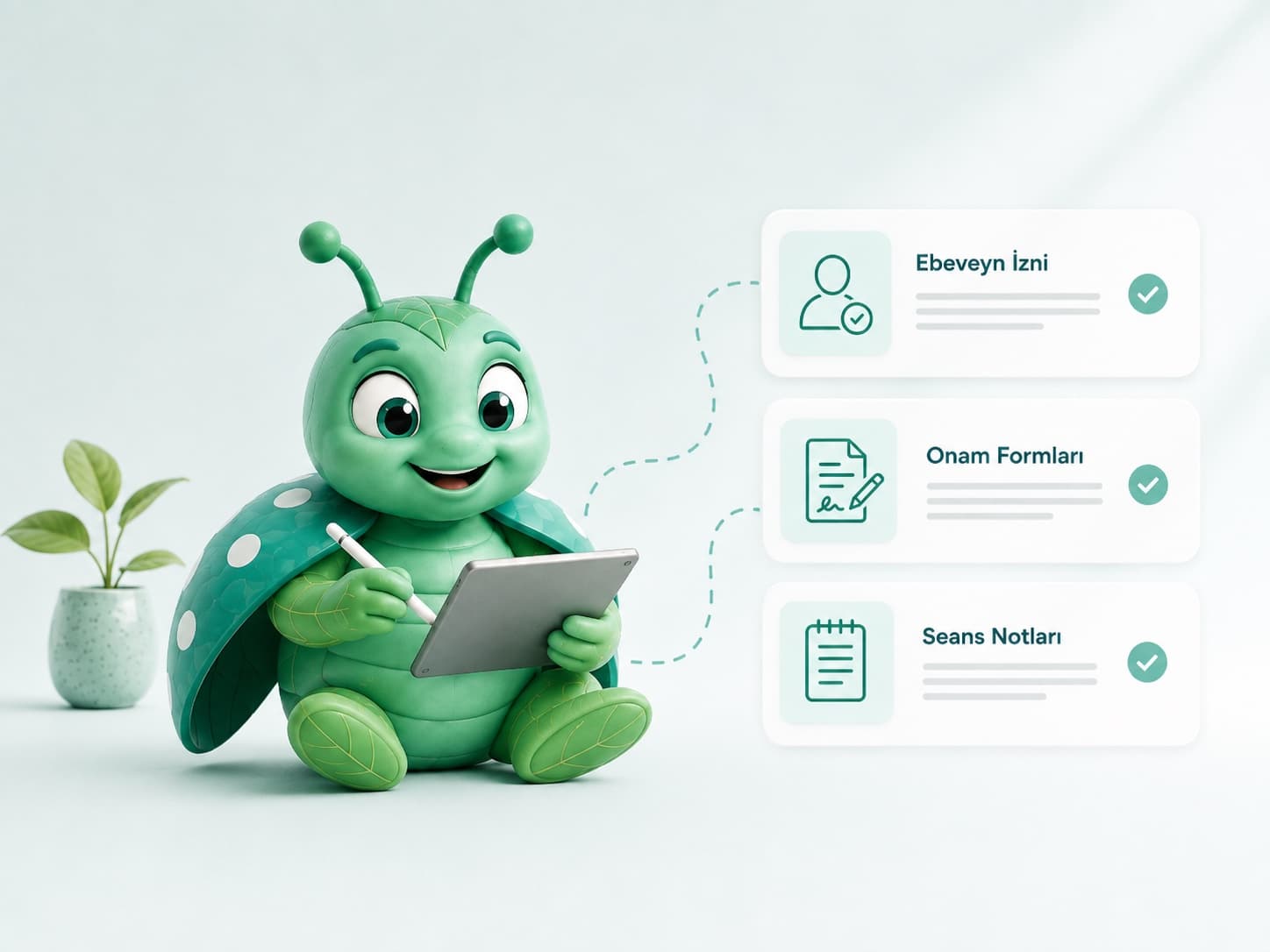
From the outside, child therapy can look like adult therapy with smaller chairs. It isn't. The person doing the actual work is a child, yet the person who signs, pays, and holds the legal authority is the parent. The story comes from the child. The consent comes from the parent. And privacy? It sits somewhere in the middle, shifting a little every year the child gets older.
That gap is the whole problem. A tool built around one adult, one file, one phone number simply has no idea what to do with a setup like this. So here's what we'll walk through: the digital setup a child and adolescent therapist actually needs, from parental consent and adolescent privacy to the parent portal that keeps everyone sane, plus what KVKK (Turkey's data protection law, closely modeled on GDPR) expects from you along the way.
What Makes Child and Adolescent Therapy Different?
The short version
In adult therapy, the client, the decision-maker, and the payer are all one person. In child therapy those roles split apart: the child does the therapeutic work, the parent holds legal authority and pays, and confidentiality gets layered by age. That single split is why generic scheduling and note tools fall short — they assume one person, one file, one line of communication.
Think for a second about who's in the room versus who's on the paperwork. With an adult, that's the same person. With a nine-year-old, it isn't, and everything downstream has to bend around that fact.
Generic tools assume one contact per file. A child practice needs two records that live side by side but stay separate: the guardian's and the child's. It needs privacy that flexes with age. It needs a way to keep parents in the loop without handing them the child's private inner world. And getting that architecture right isn't some nice-to-have extra. It protects the therapeutic alliance, and it protects you.
Who Gives Informed Consent for a Child?
When your client is under 18, informed consent under KVKK comes from the legal guardian, usually a parent. Simple enough on paper. In practice, the details are where it gets sticky.
Divorced family? The parent who holds legal custody is the one who consents. Joint custody? Then ideally you inform both. It's the ethical thing to do, and it quietly heads off a dispute six months down the road. Court-appointed guardian? Slow down here and get the guardianship document into the file before you do anything else.
Then there's the adolescent question. Turkish law recognizes a concept of "medical maturity" for some adolescents over 15, meaning they can make certain medical decisions on their own. Psychotherapy may fall inside that. May. Even so, most therapists still obtain parental consent alongside it, and honestly, that instinct is usually the right one. And if you want your consent process to actually hold up, a well-built intake form is where it starts.
Where Are the Privacy Boundaries in Child Therapy?
Privacy here has three stakeholders, not one.
The child's privacy. What a child tells you in confidence doesn't travel straight to the parent. Break that, and you break the alliance. There's no session two after that.
The parent's right to know. The guardian is entitled to a certain level of information, and to more of it when the child's safety is on the line.
Third parties. School, court, the other parent. Sharing anything that lands in this bucket needs informed consent, and it's almost always done in writing.
Those three layers have to turn into an actual policy, not a vibe. You lay them out in the first session, once with the parent and once with the child, pitched to wherever the child is developmentally. The working rule most practices land on goes like this: what's discussed with the child stays confidential, but a genuine safety concern gets shared with the parent. Say it plainly. And say it long before it ever comes up.
How Do You Set Confidentiality with an Adolescent?
An adolescent is neither a child nor an adult, and that in-between status is exactly what makes this the trickiest ground in the whole practice.
Here are a few things that tend to work in the room.
Meet the adolescent and the parent separately at the first session. Then bring all three of you together and agree, out loud, on what will and won't be shared. Put it in writing if you can, signed by both.
Safety comes first, always. Suicidal ideation, self-harm, substance use, harm to others: all of that sits outside confidentiality, and you say so on day one, not the day it actually happens.
Grades, friendships, a first relationship? That stays the adolescent's. None of it reaches the parent without the adolescent's say-so. Hold that line, and the adolescent learns something rare: that you meant what you said.
The message that arrives at 10 p.m.
A parent texts your personal number: 'What happened at school today? She won't talk to me.' It's late. You feel the pull to answer, to reassure, to say something. But you and the adolescent agreed that social topics stay hers. Answer now and you've quietly broken that, over WhatsApp, with no record of it anywhere. A parent portal absorbs the whole thing instead: the parent leaves the question in a structured space, you answer it inside the boundaries you all agreed on, and the trust holds.
Why Parent Communication Breaks Down (and Why a Portal Fixes It)
In child work, talking to parents can't be a one-off thing. It has to be steady, and it has to be structured. Run it through WhatsApp or your personal email, and three things go wrong, reliably.
Boundaries slide. There's that 10 p.m. text again, along with the nagging sense that you owe an instant reply.
KVKK risk creeps in. Information about a child gets shared and nothing records it, and the whole thread is sitting inside a consumer chat app that was never built to hold special-category data.
And information scatters. Something you covered last session is gone by this one, so the parent asks it a third time, and you answer it a third time.
A parent portal is the piece that cleans all of this up in one move. Parents get a structured, private space with exactly what they need: the child's schedule, assigned activities, your weekly summary written for them, answers to the questions that come up every single time. One detail carries the whole thing, though. Parents and children need different access levels. The child's session notes must not sit there in plain view for the parent to open.
How Should You Structure Child Therapy Notes?
Child notes aren't just adult notes wearing a different name. Three things set them apart.
Play behavior. Kids say through play what they can't yet put into words. So a slice of the note tracks play themes, the materials they reached for, the symbolism you noticed.
A separate parent-consultation note. One session often means time with the child plus a short check-in with the parent. Same file, different sections. That separation earns its keep years down the line, when the child is grown and asks to read their own record.
Developmental tracking. Children change over months, not weeks. Your notes have to stay legible across that longer arc, or the pattern just dissolves into a pile of one-offs.
A template built for child therapy carries all three by default, so you're not rebuilding the structure from scratch every session. And if you're still shaping your own format, our guide on how to write therapy session notes is a good place to start.
What Does KVKK Expect for Children's Data?
KVKK treats a child's data as a category that needs extra care. Here's what that means in plain terms.
Retention gets handled deliberately, because the child has a future right to access their own data, and that right switches on at 18.
Sharing with a school, a court, an insurer? Written parental consent, every single time. A verbal yes doesn't count.
And the duty to report a breach is tighter than usual.
Put it all together and the baseline for a child practice stops looking like optional extras. Encrypted notes, written consent workflows, access logging, all of it running by default. Not a nice-to-have. It's the floor you build everything else on. We dig deeper into the rules in our KVKK and GDPR compliance guide for therapists.
Custody Battles and Court Requests: What to Watch
Every so often, a child therapist ends up somewhere they never wanted to be: a legal case. A divorce heats up, and one parent asks you to testify, or to weigh in on who the "better parent" really is.
Two rules hold the line here.
You are the child's therapist. An expert witness is a different job, with a different mandate, and the two must never blur into one.
And if a subpoena lands, the file can be legally compelled. Which means what's in that file, and how carefully you wrote it, suddenly matters a great deal. This is exactly why child notes are best written in plain, behavioral language. Record what you observed about a parent, not what you concluded about them.
When the file gets subpoenaed
A custody hearing is set, and the court asks for the full client file. Now every line you ever wrote gets read by lawyers. A note that says 'mother seemed cold and dismissive' is an opinion, and it can be turned against a parent, or against you. 'Child stayed close to mother during play; mother responded to questions but initiated little' is an observation, and it holds up. Written carefully from session one, the file protects the child, the parents, and you. Written loosely, it turns into evidence you never meant to hand over.
Which Digital Tools Do You Actually Need?
Shopping for a scheduling and clinical tool for a child and adolescent practice? These are the features worth insisting on.
A parent portal, kept separate from the child's session data. Distinct records for the legal guardian and the child. A note template made for child therapy, with play themes and developmental tracking already baked in. A written informed-consent workflow that gives the adolescent and the parent separate signature fields. Privacy layers that draw a real line between what the parent sees and the child's own space. And a private channel to message the adolescent directly, so their confidentiality actually has somewhere to live.
Bring all of that into one system and yes, you save time. But the bigger win is quieter. The alliance stays protected, KVKK stops being a nagging worry at the back of your mind, and you're no longer juggling a tangle of layered permissions in your head between sessions.
Managing a Child and Adolescent Practice with Calemio
You already work with more nuance than most jobs will ever demand. Your software shouldn't hand you one more thing to manage on top of it.
Calemio pulls the whole setup into a single workflow built for child and adolescent practices. A parent portal with separate access for parents and children. A child-therapy note template with play themes and developmental tracking built right in. Distinct record structures for the child and the legal guardian. A KVKK-compliant written consent workflow, with encrypted notes and access logging on by default. Very few products on the Turkish market cover this category properly. You can start your free trial here.
A Quick Checklist
Taking a fresh look at how your practice handles the child-and-parent split? Here's a fair place to start.
- The guardian and the child have separate records, linked but distinct.
- Consent is captured in writing, with separate fields for the parent and the adolescent.
- Confidentiality boundaries are set at the first session and put in writing.
- A parent portal handles parent communication, not your personal phone.
- Parents and children have different access levels, so session notes stay private.
- Child notes are written in behavioral, non-judgmental language.
- Third-party sharing runs on written parental consent, never verbal.
- Notes are encrypted and access is logged by default.
Frequently Asked Questions
Who gives informed consent when the client is a child?
For clients under 18, informed consent comes from the legal guardian, usually a parent. In divorced families it's the parent with legal custody who consents, and where custody is joint, informing both parents is the safer and more ethical route. If there's a court-appointed guardian, get the guardianship document into the file before you begin anything.
Can an adolescent keep information private from their parents?
Yes, within limits. Academic and social topics generally stay inside the adolescent's own privacy and aren't shared without their consent. Safety concerns like suicidal ideation, self-harm, substance use, or risk to others fall outside confidentiality, and that boundary should be stated plainly at the first session and, ideally, put in writing.
What is a parent portal and why do child therapists need one?
A parent portal is a structured, private space where parents can see the child's schedule, assigned activities, and a therapist summary without texting you at all hours of the night. It keeps information in one place, holds healthy boundaries, and lowers KVKK risk. And with separate access levels, the child's session notes stay private and aren't automatically visible to the parent.
How should session notes for child therapy be structured?
Child notes need three things adult notes usually don't: a record of play behavior (themes, materials, symbolism), a separate section for the parent consultation, and developmental tracking that stays readable over months rather than weeks. Keeping the child's notes and the parent consultation in one file but in distinct sections also matters later, when the client wants to review their own records.
What does KVKK require for children's therapy data?
KVKK treats children's data as a category that needs extra care. In practice that means encrypted storage, deliberate retention (the child gains the right to access their own data at 18), written parental consent before sharing with schools, courts, or insurers, access logging, and a stricter breach-reporting duty. A verbal yes simply isn't enough for third-party sharing.
What should a child therapist do if a court requests the client file?
Remember that being the child's therapist and being an expert witness are two different roles that must never blur into one. A subpoena can legally compel the file, so notes should be written in plain, behavioral language rather than personal opinions about the parents. Writing carefully from the very first session is your best protection.
Related articles



Start using Calemio for free
Encrypted, compliant and simple. Built for independent therapists and clinics.
Start free