
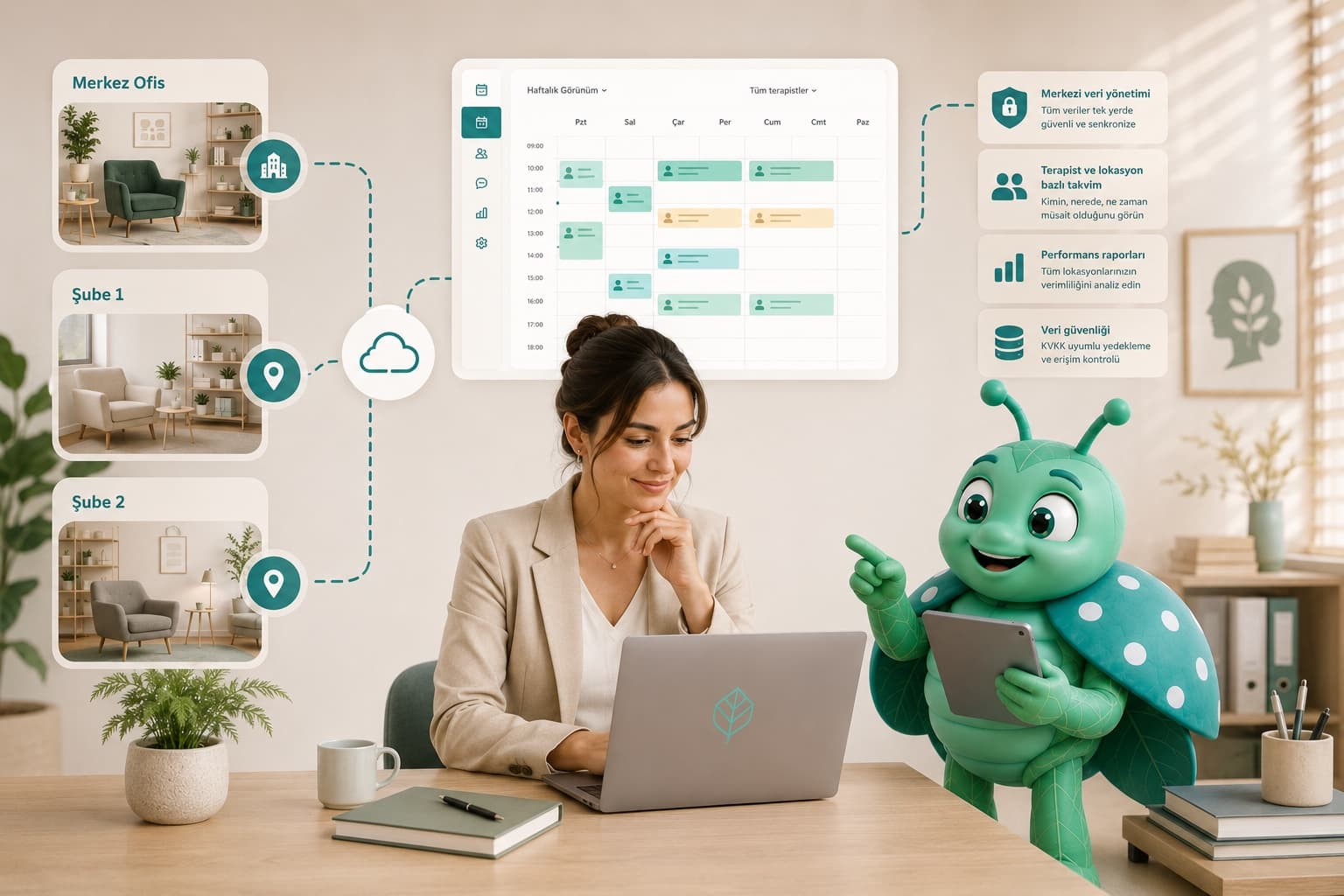
Lots of therapists split their week across two places these days. An institution from Monday to Friday, then their own room on the weekend. Or maybe two clinics on alternating days. Financially it's steady, and there's enough slack in it to actually breathe. The mess, when it comes, is on the paperwork side.
Because here's the thing: you're not just walking between two buildings. You're walking between two separate worlds of data. Which client is filed where? Whose calendar owns this slot? Did I see this person at the clinic last Tuesday, or was that my own office? Tiny questions, every one of them. And yet they chew through your week anyway. Worse, a few of them carry genuine legal weight under KVKK (Turkey's data protection law) and its EU cousin, the GDPR.
Let's untangle it. Ahead: where hybrid data tends to go sideways, where the legal lines actually sit, and the one setup that stops the two worlds from bleeding into each other.
What Is Hybrid Work for Therapists and Why Does Data Separation Matter?
The short version
Hybrid data separation means each practice you run holds its own clients, calendar and notes inside its own legal boundary. One app, sure, but separate accounts that can't peek into each other. The calendars still cross-check quietly in the background, so a double-booking never slips through. The idea's simple: two practices, zero mixed-up data.
Hybrid work simply means your practice lives in more than one place. A salaried spot during the week, your own room on weekends. Or two clinics on alternating days. You pocket the security of an employer and the freedom of running your own show, both at the same time. Hard to argue with that.
Here's the catch, though. Each place is its own island of data. Every client belongs to one practice. Every appointment sits on one calendar. Every note gets written under one specific legal responsibility, never a shared one. Let those islands drift into each other and two things follow. You start burning time hunting for records. And you quietly breach KVKK by mixing data that was meant to stay apart. Clean separation isn't a nice-to-have here. It's the foundation the whole thing stands on.
What Are the Most Common Problems of Hybrid Work?
Three keep showing up, over and over.
First up is double-booking. A client is down for Tuesday at 2:00 at Clinic A. Then a reminder for your own practice quietly drops into that exact slot. Nobody spots it until it's far too late. And you can't be in two rooms at once.
Next comes data leakage. Say the clinic refers a client to you and you'd like to bring them over to your own practice. Under KVKK, that's not a copy-and-paste job. It's a change of data controller, and it needs consent of its own. More on that shortly.
The third one is quieter. Mental fatigue. Two systems, two calendars, two different ways of writing notes, and your brain switching lanes all day long. Burnout rarely lands as one big blow. It builds up from small stuff, exactly like this.
The good news? The right setup lifts most of it off your plate.
The 09:40 that existed twice
Tuesday, 09:40. A client is already booked at the clinic where you work weekdays. That evening, from home, you drop a private client into the very same 09:40 without a second thought, because your two calendars have never once spoken to each other. Wednesday morning it hits you: two people, one you. So one of them gets a call, an apology, a reshuffle. On a setup where the calendars quietly check each other, that slot would have flagged as taken long before you booked over it.
What Are the Legal Boundaries of Hybrid Work Under KVKK and GDPR?
The rule under all of it is straightforward. Client data you handle while working for an institution sits under the institution's responsibility. Data you handle in your own practice sits under yours. Two settings, two separate legal entities. Not one blurry shared pool.
That works out in three concrete ways.
You can't simply move a client from Clinic A into your own practice. That person has to give fresh, explicit consent for the switch.
The notes living in Clinic A's system aren't yours to keep, either. Copying them into your personal archive is, in most cases, a breach of contract.
And when you send a client the other way, from your practice to an institution, you share information only with their explicit consent. Otherwise the move starts clean, as a brand-new registration on the institution's side.
None of this is exotic. It's the same principle the GDPR lays out for special-category data, health information very much included. Our guide to KVKK and GDPR compliance for therapists digs deeper if you want it. Once the lines are clear, building around them turns out to be the easy part.
How Can Hybrid Therapists Keep Clinic and Private Practice Data Separate?
There are three common ways to organise this. Squint from a distance and they look pretty similar. They aren't. The gap between them is safety, and it's a wide one. Worth a proper look before you commit.
The tag approach feels easiest, and it's the one to steer clear of. Isolated accounts hold onto the safety without the double-booking risk.
Option 1: Two Completely Separate Systems
Simplest thing on paper, really. The institution's software at the institution, your own app at home. Two programs, two databases, no overlap.
The upside? The data genuinely is separate, so the KVKK line more or less takes care of itself. And if one system goes down, the other never even notices.
The downside? The double-booking risk is thrown wide open, because the two never talk to each other. You end up forever tabbing between apps. Run both on a single phone and it gets fiddly fast. Safe, yes. Also the most exhausting way to live.
Option 2: One System, but with "Tags"
Plenty of therapists run a single personal scheduler and just label each client, clinic or private. Comfortable enough day to day. It also punches two holes.
For one, the separation is fake. A client tagged "clinic" still lives in your database, which quietly drags them out of the institution's data boundary. Under KVKK that reads as a change of controller, and it needs the client's explicit consent. Which nobody usually stops to ask for.
For another, a breach in your personal app now spills both sides at once, your clients and the institution's. Guess who the institution points the finger at. Convenient, sure. Legally, it doesn't hold up. If shortcuts like this are tempting you, the risks of tracking clients in Excel tells a very familiar story.
Option 3: Isolated Accounts
The third way is the one that actually lasts. One app, but with genuinely separate workspaces built inside it.
Here's the shape of it. You keep one Personal Account, which is your own profile. Then each practice gets its own Business Account. Data stays sealed inside each account's KVKK boundary, and one can't see into the other. The calendars, though, do murmur to each other quietly in the background, so nothing gets double-booked. Switching is a single tap from the account picker up top. And one subscription covers as many business accounts as you need.
So what does that feel like on an ordinary day? Monday morning, Clinic A. You open the app, tap into the Clinic A account, and every client, slot and note on screen belongs to Clinic A and nothing else. Come Sunday, you're at your own office. One tap, and you're in the Private Practice account. Same app. Completely different universe.
How Is the Double-Booking Problem Solved?
This is the quiet, unglamorous feature that saves your neck. The calendars talk. Their contents stay shut.
Picture it. A client is booked at Clinic A for Tuesday at 2:00. Switch over to your own practice and that slot shows up as taken, occupied, off-limits. But who's booked, and for what? Invisible. All you get is a block of unavailable time.
So the KVKK line holds, clinic data never bleeds into your private practice, and the double-booking simply can't happen. All at once.
How Should Reminder Messages and Branding Work Per Practice?
Each practice you run wears its own face. A text to Clinic A's client should read "Clinic A" at the top. A message from your own room should say something more like "Dr. Elif Kaya, Clinical Psychology." Same sender, different hat.
That's why each business account carries its own branding. Header, signature, reminder wording, the look of the intake form, all set separately, account by account.
Sounds like a small thing, doesn't it? It isn't. The client clocks it in a second, oh, that one's from the clinic, that one's from Dr. Kaya, and your work reads as that bit more put-together for it.
How Do You Keep Billing and Finances Separate?
The money side needs those same walls.
The client at Clinic A most likely pays the clinic, and you draw a salary or a cut of it. The client in your own room pays you directly, and you write the receipt. Two flows, two owners.
A good system bills and reports on each account entirely on its own. Come year-end, keeping your private-practice income apart from what the institution paid you matters a great deal for tax. Your accountant wants two clean reports, not a tangle. One account's numbers should never wander into the other's.
How Should Supervision Hours Be Tracked in Hybrid Work?
Here's one hybrid therapists tend to forget. Supervision hours don't split by workplace. They pool. Hours the institution arranges and hours you set up yourself all count toward the very same annual CPD total.
So keep those records in your Personal Account, tucked off to the side from any business account. When renewal rolls around, it's you who needs them, not the institution. We walk through the whole thing in tracking supervision hours for licence renewal.
What Do You Actually Gain?
Run two practices side by side on the right setup and the split stops feeling like a burden. Institutional security and the freedom of your own room, side by side. That's genuinely a strong place to work from.
But only with the right architecture underneath it:
- Isolated accounts, so each practice's data stays sealed inside its own KVKK boundary.
- Automatic conflict detection, so you never double-book yourself across two settings.
- Separate branding, so every reminder wears the right practice's identity.
- Separate reporting, so finances and tax stay clean, account by account.
- Intact legal boundaries, so mixed-up data never curdles into mixed-up liability.
Put those in place and hybrid work flips on you. It stops being the thing quietly wearing you down. It becomes your edge.
Manage Your Hybrid Practice with Calemio
Calemio built this isolated-accounts architecture and brought it to the Turkish market first, with hybrid-working therapists specifically in mind. One subscription, and as many business accounts as you run. Data stays sealed inside each account's KVKK boundary. The calendars talk in the background so nothing double-books. Every account carries its own branding, its own revenue tracking, its own reports, and none of it bleeds across the line. Supervision and personal records live in your Personal Account, sitting ready for the day your licence comes up for renewal.
It's the only platform in its category built this way. Start a free trial whenever you're ready.
A Quick Checklist
Rethinking how you juggle two practices at once? This is a fair place to start:
- Each practice lives in its own account, with its own KVKK boundary.
- Calendars check each other in the background, so nothing double-books.
- Clinic notes stay in the clinic's system, never copied into your archive.
- Moving a client between practices begins with fresh, explicit consent.
- Each account has its own branding on reminders and forms.
- Billing and reporting run separately, account by account.
- Supervision hours sit in your Personal Account, ready for renewal.
- A single breach can't expose both practices' clients at once.
Frequently Asked Questions
Can a hybrid-working therapist keep clinic and private practice clients in one app?
Yes, but only if the app holds each practice in a fully separate workspace. A single database with "clinic" and "private" tags won't cut it, because under KVKK it effectively pulls institution clients out of the institution's data boundary. An isolated accounts architecture, where each practice is its own account with its own KVKK boundary, lets you use one app while keeping the data legally separate.
How do I stop double-booking myself between a clinic and my own practice?
You need calendars that talk to each other even while the underlying data stays separate. In an isolated accounts setup, a slot booked at Clinic A surfaces as "blocked time" in your private practice calendar, without giving away the client or the session details. So you spot the conflict and dodge the double-booking, and no confidential data leaks between practices.
Can I transfer a client from the clinic to my private practice under KVKK?
Not by copying their records, no. Data you process at an institution belongs to the institution as the data controller, and moving it into your own practice changes that controller. The client has to give fresh explicit consent, and the transition should start as a new registration in your practice rather than a copy-and-paste of the clinic's notes.
Why is tagging clients as "clinic" or "private" a risky approach?
Tagging keeps everyone sitting in the same database, so the separation is purely cosmetic. Legally, it pulls institution clients out of the institution's data boundary without proper consent, and one single breach exposes both your clients and the institution's at once. It feels convenient day to day, but it doesn't hold up legally.
Should supervision hours be tracked separately from my practices?
Yes. Supervision hours from the institution and hours you arrange yourself all count toward the same annual CPD target, so they belong in your Personal Account rather than in any single business account. You, not the institution, are the one who needs those records at licence renewal time, so keeping them independent protects you.
How should billing be handled when working hybrid?
Each practice should run its own billing and reporting. The clinic usually collects the payment and pays you a salary or a share, while private clients pay you directly and you issue the receipt. Keeping revenue separate per account is essential come tax time, since your accountant will want two distinct reports at year's end.
Related articles




Start using Calemio for free
Encrypted, compliant and simple. Built for independent therapists and clinics.
Start free