

Almost every therapist starts here. Excel is free, it's already sitting on the laptop, and everyone knows how it works. One column for names, one for phone numbers, one for session dates. Sorted.
Then the list grows. Ten clients, then twenty, then forty. And the spreadsheet that once felt so tidy starts leaking problems. Quietly, in the background. That's the catch, really. Most of them stay hidden until one lands on you at the worst possible moment.
So let's walk through why Excel is a risky place to keep client data, the practical and legal mess it creates, and what a safer setup actually looks like.
Why Is Tracking Clients in Excel a Risk?
The short version
Excel was built for numbers, not for special-category health data. It has no real encryption, no access log, no reliable backup, and no way to prove who saw what and when. For a therapist, that's not a convenience. It's a compliance gap that stays invisible until an audit, a lost file, or a breach turns it into a fine.
For a solo practice with a handful of clients, a spreadsheet feels harmless enough. Here's the thing, though. The risk stays invisible right up until it costs you something. A file that won't open. A failed audit. A fine. Or the client trust you spent years building, gone in a single afternoon.
And remember, you're not running an ordinary business. You handle health data. Under data protection law, therapy records are special-category personal data, which comes with stricter security duties than a shop's mailing list ever would. A spreadsheet was never designed to meet those duties. That's how "free and familiar" quietly becomes "exposed and non-compliant" as your caseload grows. Our guide to GDPR compliance for therapists goes deeper on what those duties actually involve.
What Are the Risks of Tracking Client Data in Excel?
None of the problems below show up on day one. They pile up as the practice grows. And they tend to arrive all at once, on the worst possible day.
Is a password-protected Excel file actually secure?
You can put a password on an Excel file. Plenty of therapists do, and they feel safer for it. But a password-protected spreadsheet and an encrypted system? Not the same animal.
That file password can be stripped in minutes. Search for it and you'll turn up hundreds of walkthroughs, most under half an hour, none needing any real skill. Then the file leaves your machine. By email, on a USB stick, in a shared Drive folder. And that password is suddenly the only thing standing between your clients and whoever gets hold of it.
Thin line to bet a practice on.
There's a legal angle too. Under data protection law, therapy records count as special-category data, and the standard is "appropriate security measures." A spreadsheet password doesn't clear that bar.
What happens to your data when there's no reliable backup?
Ask a therapist how they back up their client list and the answer is usually some version of this: "It's on my laptop, and I copy it to a USB now and then." Three problems hide in that one sentence.
The laptop dies. Hard drives fail. When one takes a month of records down with it, there's no undo button. Anyone who has watched that little spinning wheel and felt their stomach drop knows the feeling exactly.
The USB goes missing. The backup stick slips out of a bag, gets left in a taxi, ends up who knows where. Under data protection law, that's a breach. And the clock starts. You may have 72 hours to report it to the regulator.
The cloud isn't as simple as it looks. Auto-syncing to Google Drive or Dropbox sounds like the fix, and for a while it feels like one. But where do those servers actually sit? Usually the US. And how do those companies process what you upload? The moment health data is in the mix, both questions pull you into extra contracts and due diligence you didn't sign up for.
The Tuesday the laptop wouldn't turn on
A therapist opens the laptop before a 9:40 session and gets a black screen. The drive is dead. The only client list lived in one spreadsheet on that machine, and the last USB copy was made "a few weeks ago, maybe." Session notes, phone numbers, the coming week's bookings. All of it, gone. On a system with automatic, off-device backups, none of that Tuesday happens. The list is safe on another laptop within minutes.
Why does sharing a spreadsheet lead to version confusion?
Working solo? This one barely touches you. But bring in an assistant, a supervisor, or a colleague covering your caseload, and it gets messy fast.
Two people in the same file at once, typing over each other. No record of who changed what. Someone deletes a column and never notices. This isn't a rare event. It happens weekly. Ever saved something called client-list-final-v3.xlsx? Then you already know exactly where this goes.
And this isn't just annoying. A rescheduled appointment that never saved, a session note that vanished, a phone number typed over by mistake. Those don't stay abstract. They land on real people.
Why doesn't Excel give you useful insight from your data?
Spreadsheets grow like weeds. You add a column for "paid?". Then "payment date". Then "method". Three months later there are eighteen columns, and maybe four of them are filled in the same way twice.
So you end up with plenty of data that tells you nothing. Want your no-show rate for the last quarter? In Excel that means filtering, counting, and cross-checking by hand. Which is why you never actually do it.
A practice management tool works these numbers out on its own. Excel does the reverse. It makes piling up data effortless and reading anything out of it nearly impossible.
Can you prove privacy compliance with an Excel sheet?
Say a complaint comes in. Or the regulator comes knocking. The questions tend to be pointed.
Who opened this client's file, and when? What exactly did this person agree to when they gave consent, and on what date? When you deleted their records after an erasure request, how did that happen, and can you show it?
With a spreadsheet, you can't prove a single one of those. No access log. No filed consent text. No record of the deletion. And being unable to answer is, by itself, evidence that the obligations weren't met.
When the regulator asks for the access log
A former client files a complaint and asks who has seen their file. The regulator wants an access log and the consent text the client agreed to. The therapist opens the spreadsheet and finds… a spreadsheet. No log of who opened it. No dated consent record. Nothing to show. The honest answer, "I can't tell you," is exactly the answer that turns one complaint into a finding.
How Do You Move Client Data Off Excel?
Good news: getting off Excel is far easier than the dread makes it sound. It comes down to three moves.
Step 1: Clean up the sheet. Open what you've got, delete the columns you never really used, and fix the entries that don't match. Do this before you touch any new system, not after.
Step 2: Pick a scheduling tool. Look for one that's privacy-compliant, keeps notes encrypted, and includes an intake form. Most decent software gives you a 14 to 30 day free trial, so you can try before you commit.
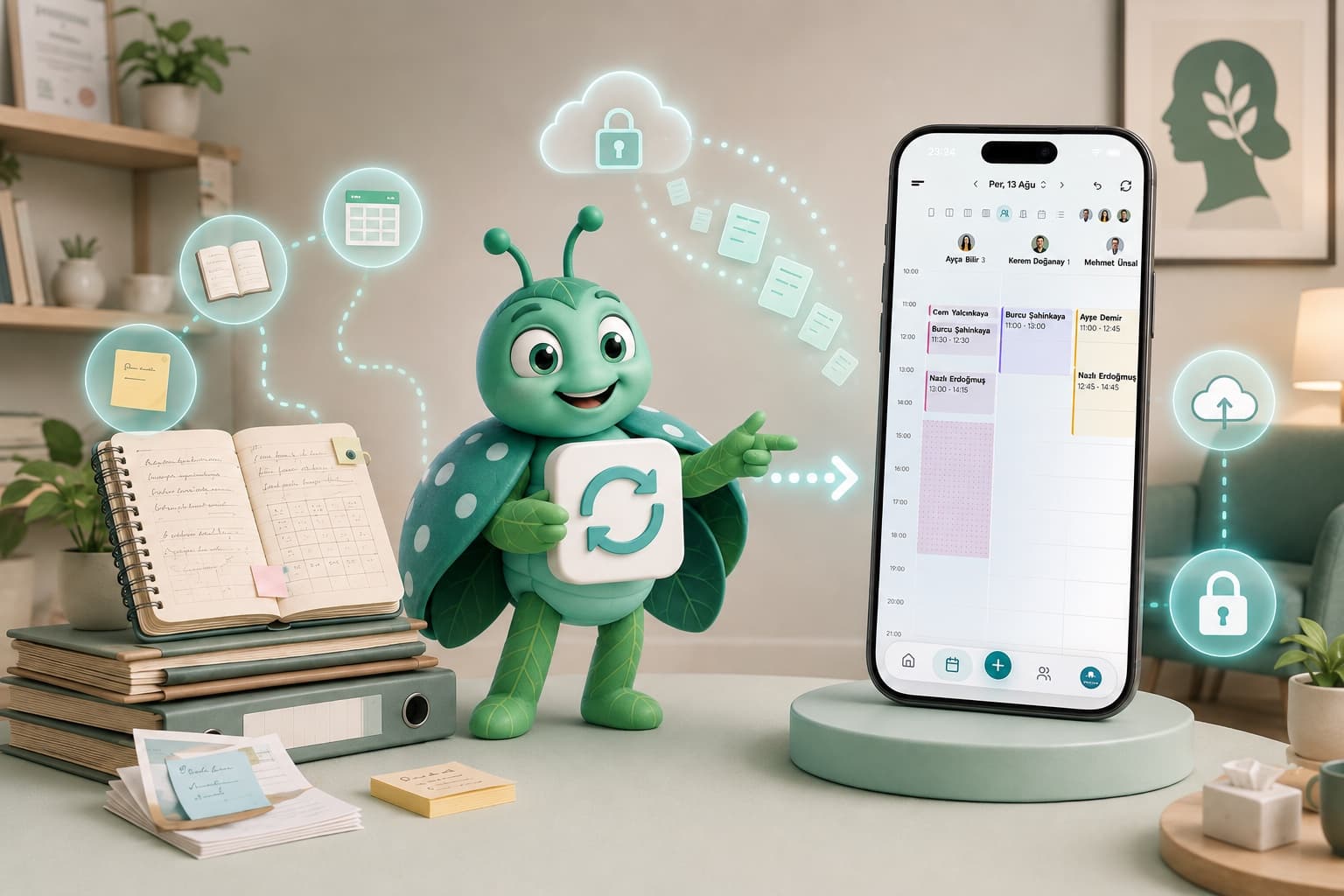
Step 3: Bring your clients over. Well-built scheduling software lets you photograph the pages of your notebook or client list and reads the names, phone numbers, and appointment details straight off the page. You review what it read, approve it, and add anyone else as you go.
The whole switch usually takes less than a weekend. Give it three days of poking around the new system and the reasons it's easier stop being theoretical. Want to see the full path first? Our guide to switching scheduling software lays it out step by step.
When Is It Still OK to Use Excel?
None of this is a case against Excel as such. It's a genuinely good tool. Just not the right home for your client data.
Use it for quick sums. A weekend revenue projection. A scratchpad while you sort out your taxes. All fine. What doesn't belong in a spreadsheet is the identifying stuff: names, phone numbers, health information. Put those there and you've made a mistake that's both legal and practical.
What Do You Gain by Switching to a Practice Management System?
Excel is free. But that "free" is doing a lot of hidden work. Weigh in a single breach, one administrative fine, the trust you'd lose, the dent to your professional name, and the savings flip into a cost surprisingly fast.
A purpose-built system quietly turns each of those risks into something you no longer think about.
- Real encryption, so client and health data is protected by default
- Automatic off-device backups with no single point of failure
- One source of truth, so no conflicting copies or overwritten notes
- No-show rates and other metrics generated for you
- An access log, filed consent, and documented deletion for audits
- A file password that can be stripped in half an hour
- "It's on my laptop", one dead drive from losing everything
- client-list-final-v3.xlsx and nobody sure which is current
- Data you can pile up but never actually read
- No proof of who saw what, when, or how it was deleted
Manage Your Clients Securely with Calemio
Calemio pulls scheduling, encrypted client records, and automated reminders into one place, so your client data lives in a compliant system instead of a spreadsheet. Privacy compliance, encrypted notes, and reminders are working from day one. And because you can just photograph the pages of your existing client list, your Excel-era records come over without retyping a thing.
There's a free starter plan too. Forever, up to 20 clients. Start your free trial here, no credit card needed.
A Quick Checklist
Wondering whether it's time to move off the spreadsheet? Run through this:
- Client data lives in an encrypted system, not a plain Excel file.
- Backups run automatically, off-device, on a schedule you don't have to remember.
- Access is role-based, and there's a log of who opened what and when.
- Consent text and its date are stored with each client record.
- Erasure requests leave a documented trail you can show later.
- Only one current version of the data exists, shared safely across the team.
- No-show and other key rates are generated for you, not counted by hand.
- Excel is reserved for sums and projections, never identifying client data.
Frequently Asked Questions
Is it legal to track therapy clients in Excel?
Storing client data in Excel is not automatically illegal, but it makes compliance very hard to demonstrate. Therapy records are special category personal data that require adequate security measures, access logs, and documented consent and deletion. A spreadsheet cannot provide those safeguards, so relying on Excel puts you at real risk of failing an audit or a complaint.
Is a password-protected Excel file secure enough for client data?
No. Excel's file-level password can be bypassed with freely available tools in under an hour, and once the file is shared by email, USB, or cloud, that password is your only protection. Password protection is not the same as encryption and does not meet the "adequate security measures" standard for health data.
What counts as a data breach when using a spreadsheet?
A lost or stolen USB backup, a spreadsheet emailed to the wrong person, or an unauthorized copy of the file all count as data breaches. Under data protection law you may be required to report such incidents to the relevant authority within 72 hours, which is difficult when you have no access log to show what happened.
How do I move my client list from Excel to a practice management system?
Start by cleaning up the spreadsheet: remove unused columns and fix inconsistent entries. Then choose a privacy-compliant scheduling tool and photograph the pages of your existing client list so the software can read the names, phone numbers, and appointment details for you to review and approve. Most people finish the whole transition in a weekend.
Is Excel ever appropriate for a therapy practice?
Yes, for tasks that don't involve identifying client data, such as quick calculations, revenue projections, or personal notes during tax preparation. The problem is only using it as the central store for names, phone numbers, and health information, which belongs in a secure, encrypted system.
Related articles



Start using Calemio for free
Encrypted, compliant and simple. Built for independent therapists and clinics.
Start free