ChatGPT went public in 2022, and within weeks every industry was arguing about what AI would do to it. Therapy included. But this corner of the debate lands differently, and harder, because privacy isn't one feature of therapy among many. It's the ground the whole thing stands on. The rawest thing a client ever says to you simply cannot end up feeding some model.
And yet. AI is also the tool that could hand you back an hour or two a day. The hours you currently pour into scheduling, reminders, chasing confirmations that never come.
So which is it? A threat, or a relief? Could it somehow be both?
That tension is what this piece is about. Where AI is genuinely safe to use in a practice, where it has no business going at all, and how an assistant like Mio is built so that line actually holds.
What Does "AI in Therapy" Actually Mean?
The short version
There are two completely different things people mean by 'AI in therapy'. One tries to replace the therapist by talking to the client directly. The other stays in the back office, handling scheduling, reminders and admin, and never touches the clinical work. This article is only about the second kind, the safe kind.
The word "AI" is doing a lot of work in that phrase, and it hides a split that matters enormously.
Type one: AI that stands in for the therapist. The so-called "chatbot therapist". The client talks to the software, and the software tries to do something clinical with what it hears. This carries real ethical and clinical risk, and most professional bodies land in the same place on it: not recommended.
Type two: AI that works next to the therapist. It takes the admin. Scheduling, reminders, transcription, reporting. It doesn't do therapy. It just lifts the weight of everything around the therapy.
This article is about the second one. The first is a serious debate in its own right, but it's a whole different conversation.
What Can AI Safely Do for a Therapist?
Plenty, as it turns out, once you keep it in its lane. Here's what an admin assistant like Mio actually handles across an ordinary week.
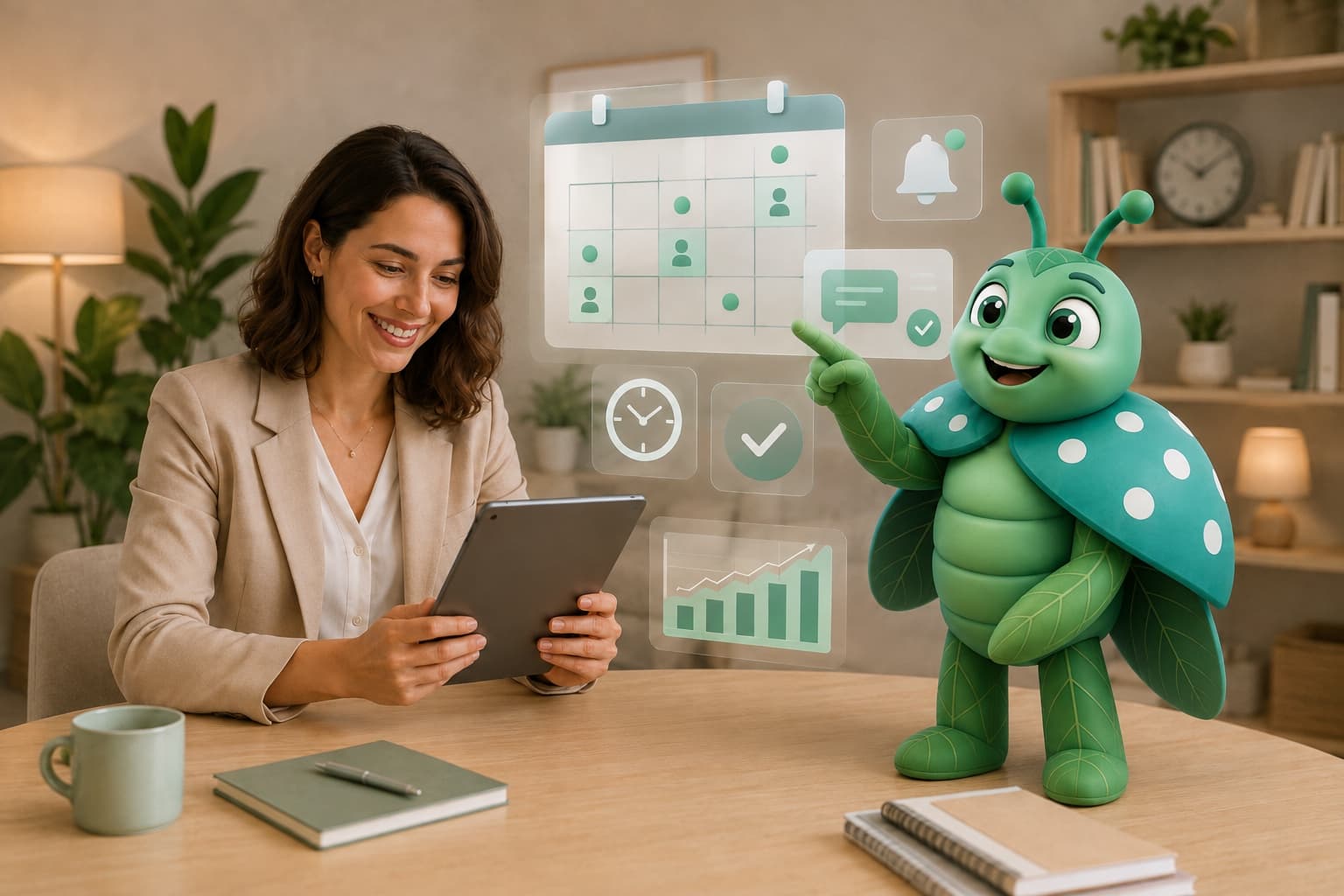
It schedules. You type something like "book E.K. a 50-minute session next Tuesday at 2," and that's the whole interaction. Finding the open slot, sending the confirmation, checking nothing already sits in that space, all of it happens without you clicking through a calendar.
It handles the back-and-forth. A client replies to a reminder. Mio reads whether that reply means "yes, I'll be there" or "can we move it," and acts on it. You never get pulled into the thread.
It reads the situation before it sends a thing. New client? The consent form goes out. Returning client? Just the confirmation, nothing extra. The right message for the moment, not a blast of the same template at everyone.
And it warms you up before a session. Ten minutes before someone walks in, the notes from last time surface on their own. No scrambling to recall where you left off.
A Tuesday at 2 that books itself
You're between sessions and a client texts asking to come in next week. You type 'give E.K. 50 minutes next Tuesday at 2.' Mio checks the slot is free, blocks it, and sends E.K. a confirmation in plain, human Turkish. No calendar app, no double-checking your other Tuesday bookings, no template that reads like a robot wrote it. Two minutes of your attention, spent once, and the rest handled.
Add those small things up over a day and it's real time. In practice, therapists using this kind of assistant claw back somewhere between an hour and a half and two hours daily. Curious what that would look like as a number for your own practice? Here's how to reduce client no-shows, which is where a lot of that reclaimed time comes from.
Is AI Safe in Therapy? How Your Client Data Is Protected
Fair questions, and you should absolutely be asking them. Does an app that runs on AI also get to see your client data? Does it feed that data back into its own training? Does any of it leak out to third parties?
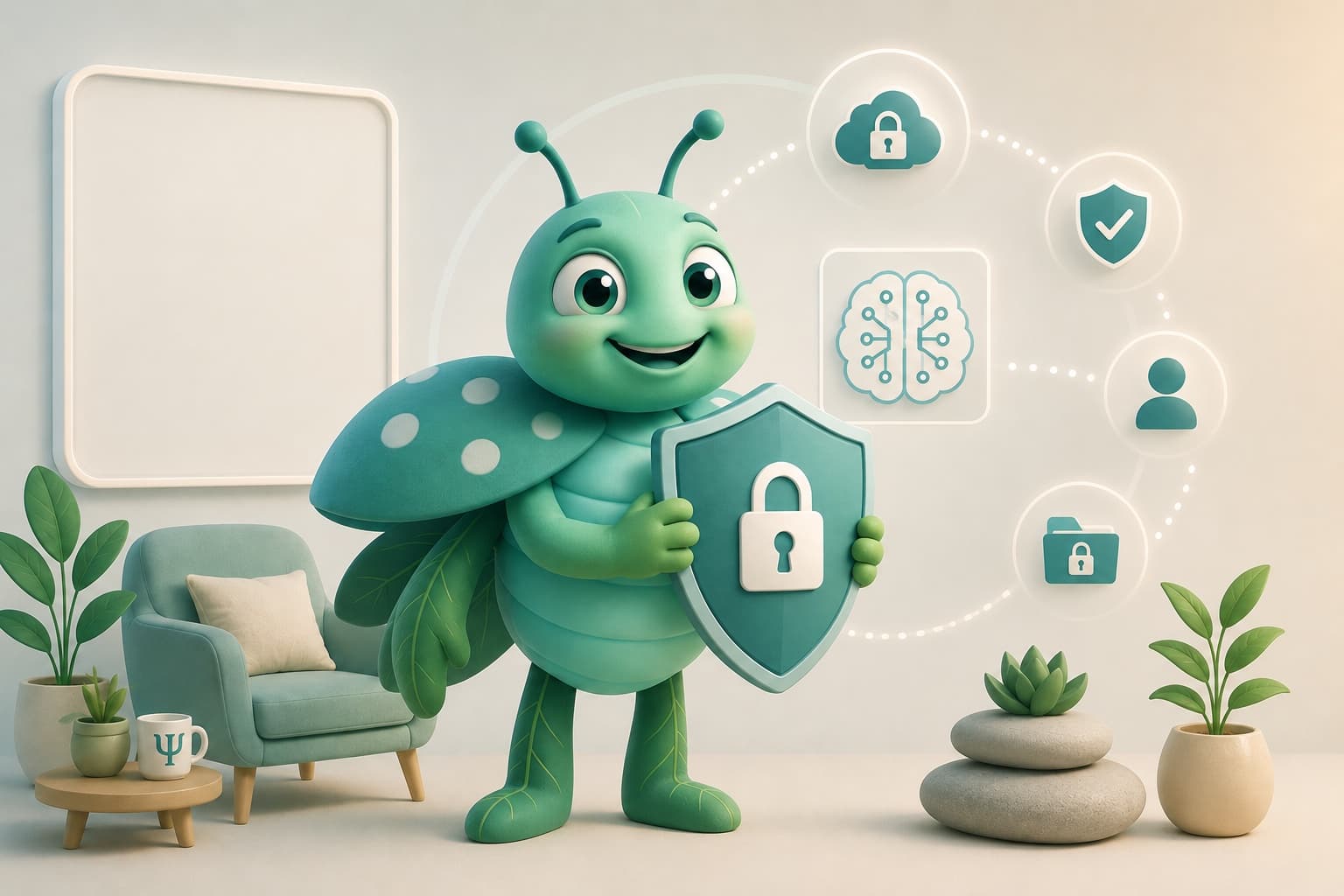
This is exactly where the design either earns your trust or doesn't. Mio's rests on three commitments.
Your notes never train anything. Not ever. This isn't a line on a marketing page, it's written into the contract. Which therapist wrote which note about which client, that mapping is never surfaced, not even inside the company.
Everything is encrypted end to end. AES-256, the modern standard. Data lives in EU data centers. No third party reaches into it.
The AI only ever sees the sliver it needs. When it sends a reminder, it can see the appointment basics, the time, the client's name, the session type. It cannot see the session notes. Minimum access, by design, not by promise.
What the AI sees when it sends a reminder
It's Monday evening. Mio is queueing up tomorrow's reminders, including a Tuesday 09:40 with a client logged as B.A. To send it, the AI needs the name, the time and the session type. That's what it pulls. Your notes on B.A., the ones from three sessions ago about the thing they've been working through, stay sealed off. The reminder goes out. The clinical record never gets opened.
Put together, this is what lets you take what AI offers without giving up KVKK compliance, GDPR standards, or the ethical line therapy runs on. For the fuller picture on the legal side, our guide to KVKK and GDPR compliance for therapists goes deeper.
Is It Safe to Record and Transcribe Sessions?
Some AI tools offer to record your sessions and hand back a transcript. Tread carefully here. This is about as sensitive as data gets.
In Mio, audio-based notes are optional. Switch it on and here's how it works:
The recording is encrypted end to end. It's processed on your own device, not shipped up to the cloud and left sitting there. Once the transcript exists, the audio file gets deleted. And the client has to give a separate, explicit yes to it, on top of everything else they've already consented to.
You never have to turn it on. Leave it off and every other part of Mio keeps working exactly as before. Nothing depends on it.
What Should an AI Assistant Never Do?
The reason the AI doesn't replace the therapist isn't goodwill. It's hard limits. Mio does not cross these:
It makes no clinical calls. You'll never get a "CBT would probably suit this client better" out of it.
It doesn't diagnose. It doesn't read into session content and form a view about anyone.
It doesn't do therapy with your clients. It can chat, it can book, but ask it "how do I deal with my anxiety" and it doesn't answer. It says, in effect, "I'll pass this along to your therapist," and it does exactly that.
And it never runs a session in your place. Mio is an assistant. Not a therapist. That boundary is held in the contract and in the code, both.
Those limits are the whole point. They keep the AI parked where it's genuinely useful, and they leave everything past that line to a human professional. Which is where it belongs.
Do You Have to Tell Clients You Use AI?
Two questions come up again and again once a practice starts leaning on AI. Both deserve a straight answer.
Should clients know? As a rule, yes. A short line in the first session or on the consent form does it: "I use an AI-assisted tool for appointment reminders and admin communication." Good practice, ethically and legally. And most clients don't blink at it. Plenty read it as a sign you run a tidy, modern practice.
If the AI slips up, who's on the hook? You are. A reminder goes to the wrong person, an appointment gets logged an hour off, the responsibility still sits with the therapist. The AI is a tool, and the person wielding a tool answers for what it does. That's precisely why a well-built system routes anything critical through your approval first, rather than acting on its own.
Should You Adopt AI Now or Wait?
By 2026, AI-assisted practice management has quietly slid from "nice to have" toward "table stakes." Give it a few years and a big chunk of the admin will just be automated by default, everywhere you look.
Sitting in that shift, you've got two moves.
Wait it out. Stick with the old systems until the dust settles and the standards firm up. No risk there. Except the two hours a day you keep spending, every single day, that you never get back.
Move early, but pick carefully. Bring AI into the practice now, and choose a system with KVKK compliance you can actually point to and ethical boundaries that are built in rather than bolted on.
What to Look For in a Safe AI Assistant
AI isn't dangerous in and of itself. It's the design that decides. An AI that trains on your notes is a genuine problem. An AI that's contractually barred from touching them and only ever takes the admin off your plate is one you can actually breathe around. When you're sizing up a tool, run it against this:
- Training exclusion: a written guarantee your notes never train a model.
- End-to-end encryption: data protected with a modern standard like AES-256, stored in a compliant region.
- Minimum-access design: the AI sees the context it needs and nothing of your session content.
- Clear functional limits: no clinical decisions, no diagnoses, no therapeutic interventions.
- Transparency: an open, published account of exactly how the AI handles your data.
Miss any of these and you're not looking at a safe assistant. You're looking at a risk with a friendly interface. Want the ground rules first? Start with what therapist scheduling software actually is.
How Calemio and Mio Keep AI Safe in Therapy
Calemio was built for exactly the therapist who chooses "move early, but pick carefully." The Mio assistant is KVKK-compliant, encrypted, and boxed inside clearly drawn limits. Your notes never train a model, full stop. Data is encrypted end to end. The AI only ever reaches the context it needs. Calemio's AI disclosure statement lays all of it out in the open, nothing buried.
Want to see how it feels in your own week? Start a free trial and put Mio to work. No card needed.
Frequently Asked Questions
Is it safe to use AI in therapy practice?
It depends entirely on how the AI is designed and what it is used for. An administrative AI that handles scheduling and reminders, keeps your notes out of model training, encrypts data end-to-end, and only accesses the minimum context it needs is safe. AI that tries to replace the therapist or that trains on your clinical notes is not.
Does an AI assistant read my clients' session notes?
A well-designed assistant like Mio does not. It operates on a minimum-access principle, so when it sends a reminder it only sees basic appointment data such as the time, client name, and session type. Session notes are not exposed to the AI, and they are never used to train models.
Is using AI in therapy KVKK and GDPR compliant?
It can be, provided the system stores data encrypted, keeps it in a compliant region, prevents unauthorized access, and does not use client data for training. Mio applies AES-256 encryption, stores data in EU data centers, and treats training exclusion as a contractual commitment, which keeps it within KVKK (Turkey's equivalent of GDPR) and ethical standards.
Should I tell my clients that I use an AI assistant?
Generally, yes. Adding a short note to your first session or consent form, explaining that an AI-assisted tool handles appointment reminders and administrative communication, is good practice both ethically and legally. Most clients receive this as neutral or even reassuring.
Is it safe to record and transcribe therapy sessions with AI?
Only with the right safeguards, and only if you choose to. In Mio this feature is optional: recordings are end-to-end encrypted, processed on your device rather than backed up to the cloud, and the audio file is deleted once a transcript is produced. It also requires additional explicit consent from the client, and you can leave it turned off entirely.
If the AI makes a mistake, who is responsible?
The therapist remains responsible. AI is a tool, and the user is accountable for the tool's errors, so if a reminder goes out incorrectly or an appointment is logged wrong, that responsibility stays with the practitioner. This is why a good AI system routes critical decisions through the therapist's approval.
Related articles


Start using Calemio for free
Encrypted, compliant and simple. Built for independent therapists and clinics.
Start free